Cracked or slipped roof tiles
A cracked, chipped or slipped tile is common on a concrete or clay roof and rarely a leak on its own, because the underlayment beneath it is what keeps water out. The trouble comes when that felt is old. A handful of broken tiles on a roof with sound underlayment is an afternoon's repair; the same tiles over brittle felt are a sign the whole roof is nearing the end.
The symptom
What you are seeing
- From the ground, a tile that is a different color from its neighbors, a gap in the pattern where one has slid down the slope, or a piece of tile lying in the gutter or the garden. After a windstorm there may be several. Cracks are harder to see: look for a dark line across a tile, or a corner missing. Inside, there may be nothing at all, or a faint stain that appears only after long rain.
- Do not walk the roof to look. Concrete and clay tiles break under a boot placed in the wrong spot, and the roof that had two cracked tiles has six by the time you climb down. Use binoculars, or a phone on a pole. Note how many tiles are affected and whether they are scattered across the roof or grouped in one area, such as along a walkway where someone has been up to clean gutters or install something.
Most likely first
Likely causes
Someone walked on the roof
Gutter cleaners, satellite installers, painters and solar crews all cross tile roofs, and each footstep on the wrong part of a tile cracks it. A line of broken tiles from the eave to a vent or an antenna is the usual signature.
A falling branch or debris
A limb that comes down in a storm breaks whatever it lands on. Tiles below an overhanging tree, or below a higher roof that sheds debris, are the ones most likely to be hit.
Fasteners and clips that have failed
Tiles at the eaves, along hips and near the ridge are nailed or clipped. When those fixings rust through or the batten they are driven into rots, a tile slips out of its course in the next strong wind.
Age and weather
Old clay tiles become brittle and shed their surface; concrete tiles can crack along their length as they age. A roof where tiles are failing without being touched is telling you about the tiles themselves.
Movement in the roof beneath
Sagging battens or a deck that has moved leave tiles unsupported, and they crack under their own weight and the weight of rain. This is rare and it is serious, and the pattern of breaks gives it away.
The honest rule
Repair or replace
A few cracked or slipped tiles on a roof whose underlayment is still supple are a repair: the broken tiles are lifted out, the felt beneath is checked and the replacements are slid in and fixed. Matching tiles for an older roof can take some finding, and a repair with a near match on a rear slope is better than leaving a gap. The thing to insist on is that the felt is inspected, not just covered.
The roof itself is the question when the underlayment under the broken tiles crumbles when touched, when the battens are rotten or when tiles are breaking on their own across the roof rather than where someone has walked. The tiles on many of these roofs are still good; the felt beneath them is not. In that case the honest recommendation is to lift the tiles, replace the underlayment and battens and relay the same tiles, which is a much bigger job than replacing a dozen tiles and a much smaller one than a new roof. We will tell you which of the three you are looking at after seeing the felt, not before.
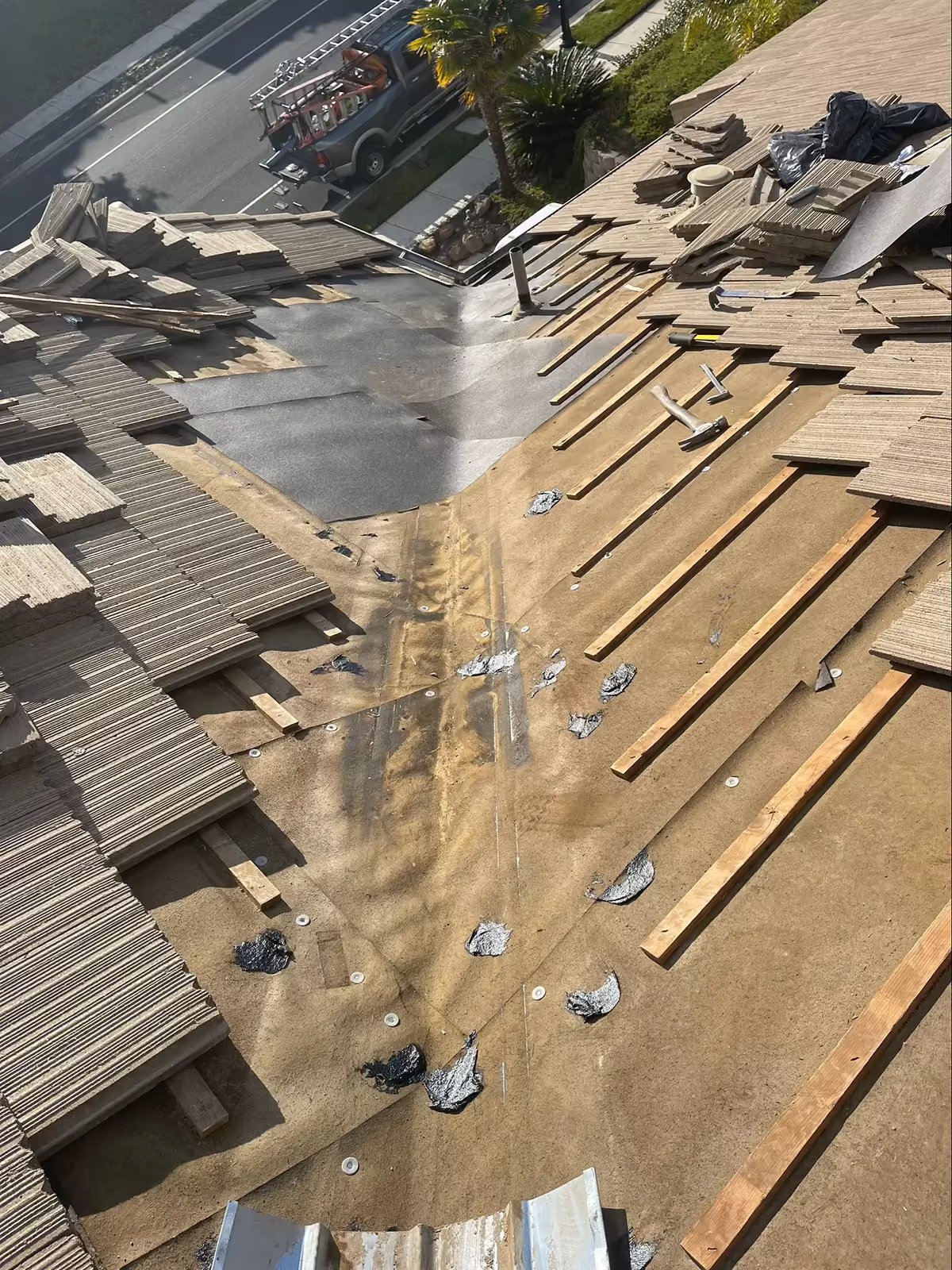
What fixes it
The service for this, and where to read more
Service
Roof leak repair
We trace where rain gets into the roof and explain the repair needed at its source.
Service
Roof inspections
A roof assessment with photographs, a written report and a clear explanation of what needs attention.
Service
Re-roofing
We remove the old covering, inspect the deck and rebuild the roof over a sound base.
Guide
Roof repair or replacement
A repair is worth considering when the damage is limited and the surrounding roof is in good condition.
Related problem
Roof leaks only when it is windy
Rain that falls straight down runs over a roof.
Related problem
Moss growing on the roof
Moss grows where a roof stays damp: the north slope, under trees, wherever fog sits in the mornings.
Questions
Asked about this problem
A tile is cracked but the roof is not leaking. Do I need to do anything?
Yes, but not urgently. The underlayment is doing the tile's job for now, and every rain wears it a little more. Replacing the tile before the next wet season keeps the felt dry and the repair small. Leaving it for years is how a single tile turns into a patch of failed underlayment.
Can broken tiles be glued or sealed?
A hairline crack can sometimes be sealed as a stopgap, but the seal fails with the tile's expansion in the sun and the water goes back to running under it. Replacing the tile is not much more work than sealing it properly, and it lasts. Slipped tiles should be refixed, not stuck.
Will you be able to match my old tiles?
Often, and when we cannot, we can usually move a matching tile from an inconspicuous slope to the visible one and put the near match at the back. Salvage tiles exist for many discontinued profiles. A perfect color match on a weathered roof is not realistic; a sound fit is what matters.
Free estimate
Find out what it costs
Tell us what's happening at your property, one step at a time. We'll review your request during business hours and arrange a free inspection.
What happens after you send it
- We call during business hours to set a time.
- A free visit. We measure on site and nothing is signed at the door.
- The proposed work and the price, in writing.
- (925) 555-0100Phone
- Mon–Fri 7:00 AM – 5:00 PMHours
Sat by appointment · Sun closed
100 Example Road, Brentwood, CA 94513 · office@example-roofing.demo
Your property answers are saved in this browser as you go. About saved answers.
Having trouble? Use the short form
Thanks. We will call during business hours to set up the inspection.
That did not send. Call (925) 555-0100 instead and we will take the details over the phone.